CKO Bayonne
Full Body Kickboxing Workout Routine: 30-Minute Plan
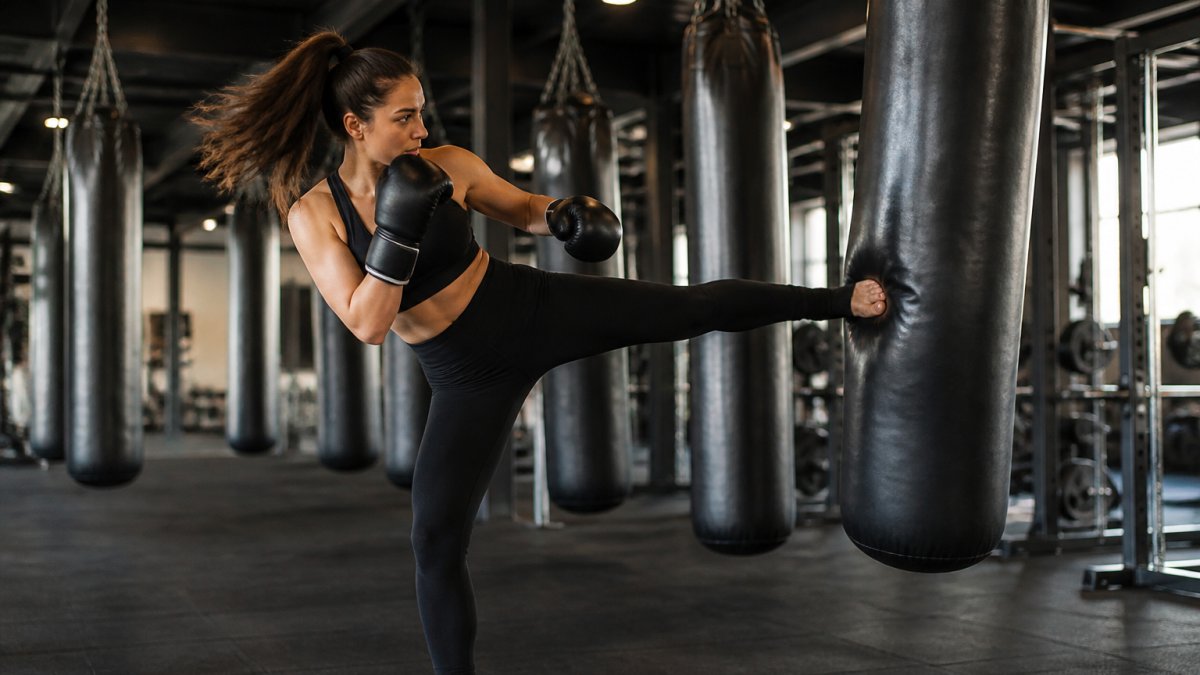
Last Updated: October 23, 2026
Quick Summary
A full body kickboxing workout routine is a timed circuit of punches, kicks, footwork, and conditioning drills that trains your upper body, lower body, and core in the same session. Our eight-round kickboxing workout takes about 30 minutes, with 2 minutes of work and 30 seconds of rest per round, warm-up included.
- Rounds 1 through 3 build punches and footwork, while rounds 4 through 6 add kicks, core work, and conditioning.
- The warm-up takes about five minutes and includes hip circles, leg swings, and 90 seconds of half-speed shadowboxing.
- Aim for three sessions a week, starting with two 30-minute days and one longer day building toward 45 to 60 minutes.
- On a heavy bag, wear gloves or hand wraps and start at 50% power to keep your form.
- Track resting heart rate, rounds completed, and waist measurement instead of relying on the scale.
Table of Contents
- What a Full Body Kickboxing Workout Routine Actually Looks Like
- What You'll Need Before Your First Round
- The Warm-Up: 5 Minutes to Loose Hips and Ready Hands
- Step-by-Step: The 30-Minute Cardio Kickboxing Workout
- Technique and Safety for Every Punch and Kick
- Kickboxing Heavy Bag Workout: How to Use a Bag Without Wrecking Your Hands
- Beginner Kickboxing Workout at Home: No Equipment, Small Space
- Kickboxing Workout for Weight Loss: What the Research Shows
- Frequently Asked Questions
What a Full Body Kickboxing Workout Routine Actually Looks Like
A full body kickboxing workout routine is a timed circuit of punches, kicks, footwork, and conditioning drills that trains your upper body, lower body, and core in the same session. The payoff is real: a five-week study found that healthy men in their twenties improved upper- and lower-body power by roughly 7% and cut more than one second from their 50-meter time (Journal of Sports Science and Medicine study on kickboxing training).
You are not lifting for 40 minutes and then doing cardio for 20, you do both at once, and the clock tells you when to stop.
The Round Structure That Holds It Together
Kickboxing workouts run on rounds: a fixed block of work, usually 2 to 3 minutes, followed by a short rest. This keeps you moving, forces short bursts of effort where the cardio benefit lives, and gives beginners a clear finish line every few minutes.
The routine below uses eight rounds. Rounds 1 through 3 build your punches and footwork. Rounds 4 through 6 add kicks, core work, and conditioning. Rounds 7 and 8 are the finisher and cool-down. Total time: about 30 minutes, warm-up included.
What You'll Need Before Your First Round
You need very little, and that is the point:
- Space: a 6-by-6-foot clear area, enough to step and turn without hitting furniture
- Footwear: athletic shoes with grip, or bare feet on a mat
- Water: within arm's reach, because you will sweat
Skip wrist and ankle weights for now. Adding load to fast punches stresses joints before your form is solid.
The Warm-Up: 5 Minutes to Loose Hips and Ready Hands
A generic five-minute warm-up is not enough for a routine that asks you to snap kicks and rotate through punches.
Work through this sequence without resting. Total time is about five minutes.
- March in place with arm swings - 60 seconds. Swing the arms across the body, not just up and down.
- Arm circles - 30 seconds forward, 30 seconds back. Start small and grow the circle each rep.
- Hip circles - 30 seconds each direction, hands on hips. The most important item for kickers, because roundhouse kicks are a hip rotation, not a leg swing.
- Bodyweight squats - 10 slow reps. Sit back, keep the chest up, and pause at the bottom for a one-count.
- Standing torso twists - 10 each side. Rotate from the ribcage, not the lower back, and let the rear heel pivot.
- Leg swings - 10 front-to-back and 10 side-to-side per leg. Hold a wall for balance. Front-to-back opens the hip flexors for front kicks; side-to-side opens the adductors for roundhouses.
- Ankle circles and calf raises - 10 circles each direction per ankle, then 15 calf raises. Your ankles absorb every landing and drive every kick.
- Shadowboxing at half speed - 90 seconds. Light and loose: slow jabs, crosses, and hooks, stepping in your stance. This is the dress rehearsal for round 1.
- High knees - 30 seconds. Keep it controlled; this is a pulse raiser, not a sprint.
- Shoulder rolls and neck turns - 30 seconds. Roll the shoulders back and down, then turn the head slowly side to side.
Shadowboxing and leg swings matter most: shadowboxing wakes up your stance and footwork before you ask them to work at speed, and leg swings tell you whether your hips are ready for kicks.
Warming up for a heavy-bag session? Add 30 seconds of light punches on the bag so your wrists and knuckles adapt to impact before round 1.
Step-by-Step: The 30-Minute Cardio Kickboxing Workout
This 30-minute cardio kickboxing workout uses eight rounds of 2 minutes with 30 seconds of rest between them. Set a timer and follow the order exactly, because each round builds on the last.
Rounds 1-3: Punch Combinations and Footwork
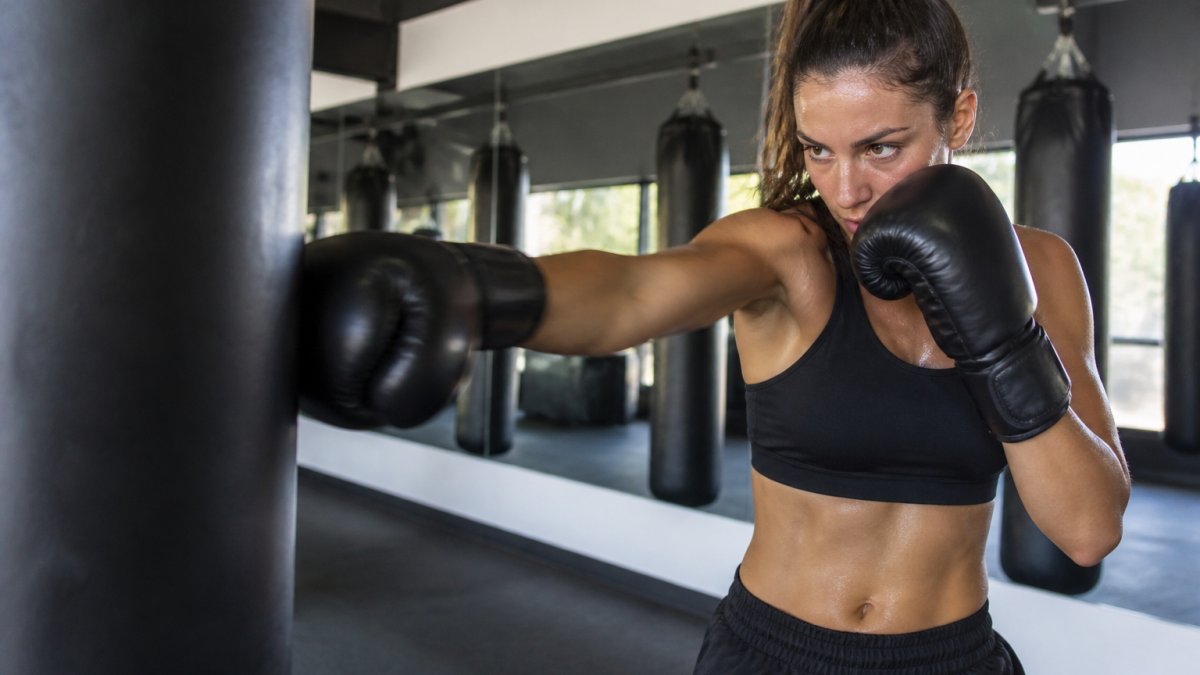
Round 1 - Jab and cross. Stand in your stance, guard up. Throw a jab with your lead hand, then a cross with your rear hand.
Round 2 - Add the hook. Jab, cross, lead hook. The hook comes from your shoulder and hip, not your elbow.
Round 3 - Footwork focus. Move forward two steps, throw a jab-cross, move back two steps. Repeat. This trains balance and stance recovery, where most beginners lose form.
Rest 30 seconds between each round. Breathe through your nose when you can.
Rounds 4-6: Kicks, Core, and Conditioning
Round 4 - Front kicks. From your stance, drive your rear knee up and snap the lower leg forward. Alternate legs every 10 reps.
Round 5 - Roundhouse kicks. Turn your lead foot out, swing the rear leg through, and strike with the top of your foot or shin.
Round 6 - Core and conditioning. Alternate 30 seconds of each: plank, bicycle crunch, mountain climbers, and squat pulses.
Rounds 7-8: Finisher and Cool-Down
Round 7 - Finisher. Thirty seconds each of fast jabs, high knees, squat jumps (or step-outs if jumping bothers your knees), and shadowboxing at full speed. Repeat twice.
Round 8 - Cool-down. Slow walking, then static stretches for your hips, calves, chest, and shoulders. Hold each stretch 20 to 30 seconds.
| Round | Focus | Duration | Rest |
|---|---|---|---|
| 1-3 | Punches and footwork | 2 min each | 30 sec |
| 4-5 | Kicks | 2 min each | 30 sec |
| 6 | Core and conditioning | 2 min | 30 sec |
| 7 | Finisher | 2 min | 30 sec |
| 8 | Cool-down | 2 min | None |
Technique and Safety for Every Punch and Kick
Form separates a workout that builds you up from one that leaves you with a sore wrist.
Punches. Keep your wrist straight and tight at the moment of impact.
Kicks. Turn your planted foot before you swing. Kicking with a locked hip is how people strain hamstrings and knees.
Guard. Your rear hand stays near your jaw at all times. Dropping it is the single most common beginner habit.
Stop the session if you feel sharp joint pain, dizziness, or shortness of breath that does not settle during rest. Sore muscles are normal. Pain that is sharp or one-sided is not.
Kickboxing Heavy Bag Workout: How to Use a Bag Without Wrecking Your Hands
A kickboxing heavy bag workout adds resistance and feedback shadowboxing cannot match: the bag tells you instantly whether your punch landed straight. Use the same eight-round structure, with these adjustments:
- Wear gloves or hand wraps. Non-negotiable on a bag.
- Start at 50% power. Beginners swing too hard and lose form by round 3.
- Aim through the bag, not at it. Punch as if the target sits two inches behind the surface.
If you own a bag, place it so you can circle it. Our classes at CKO Kickboxing are built around real heavy bags, not air, so every punch lands on something solid.
Beginner Kickboxing Workout at Home: No Equipment, Small Space
A beginner kickboxing workout at home works with zero equipment and no garage. Adapt the eight-round routine to a small space:
- Swap forward movement for pivots. Instead of stepping forward, pivot on your lead foot and reset.
- Keep kicks low. Aim front kicks at knee height, which needs less room than head height.
- Use a pillow or cushion as a target. Hold it against a wall for straight punches, or have a partner hold it.
Kickboxing Workout for Weight Loss: What the Research Shows
A kickboxing workout for weight loss works because it combines cardio and strength training in one session, so you burn calories while building muscle that keeps your metabolism working between sessions. But "it burns calories" is not a plan. Here are the numbers, the schedule, and how to measure progress.
What the Research Actually Shows
The research base is small but encouraging. In a randomized study published in the Journal of Sports Science and Medicine, 30 subjects were split into groups, with 15 assigned to five weeks of kickboxing training (study summary on kickboxing and physical fitness).
That is roughly the schedule to aim for: three sessions a week, one hour each. A 30-minute routine done three times weekly is a reasonable starting point, and you can build toward the full hour as your conditioning improves.
How Many Calories a Session Burns
Exact calorie burn depends on body weight, effort, and how much of each round you spend working versus resetting, so treat any single number as an estimate.
That is why the round structure matters for weight loss: two minutes of continuous work with 30 seconds of rest keeps your heart rate elevated across the whole session. If you find yourself resting inside the round, shorten the combinations and keep the feet moving.
The Weekly Schedule That Works
Three sessions a week is the target, and the sessions do not need to be identical:
- Two 30-minute routine days. Use the eight-round routine in this article. These are your skill and conditioning days.
- One longer day. Build toward 45 to 60 minutes by adding two extra punch rounds and one extra kick round, or by doing the routine twice with a five-minute break between.
- One optional low-impact day. A walk, a bike ride, or a mobility session. Recovery is part of the program, not a break from it.
If three sessions is too much at first, start with two and add the third in week three. Consistency beats intensity every time.
How to Measure Progress
The scale is the worst progress tracker you have: it moves slowly and reacts to water, salt, and sleep. Track these instead, once a week, same day and time:
- Resting heart rate. Most beginners see it drop a few beats per minute over four to six weeks of consistent training.
- Rounds completed at full effort. Finishing all eight rounds without backing off in round 7 means you are fitter than a month ago.
- Work-to-rest ratio. Start at 2 minutes of work to 30 seconds of rest. When that feels manageable, move to 3 minutes of work to 30 seconds of rest, or cut rest to 20 seconds. This is the simplest progression in kickboxing and the one most programs never explain.
The Honest Caveat
No workout routine guarantees weight loss on its own. Nutrition, sleep, and consistency do most of the work. Kickboxing gives you a high-calorie-burn session you will actually show up for, which is where most programs fail.
That consistency is where a class helps. Our members tell us the energy in the room is what keeps them coming back. One put it plainly: "I've tried every gym in town and nothing comes close to CKO. The energy in class is unlike anything else. I've lost 28 pounds and I actually look forward to coming in."
Frequently Asked Questions
How long should a full body kickboxing workout last?
Thirty to forty-five minutes covers a warm-up, six to eight working rounds, and a cool-down. A five-week study published in the Journal of Sports Science and Medicine had participants train about one hour per day, three times per week, and they improved upper- and lower-body power by roughly 7% while cutting more than a second from their 50-meter time. If you are new, start with 30 minutes three times per week and add rounds as your conditioning improves. Consistency across weeks matters more than the length of any single session.
What equipment do you need for a kickboxing heavy bag workout?
A heavy bag, hand wraps, and gloves are the core setup. Wraps protect your knuckles and wrists, and 12- to 16-ounce gloves absorb impact. If you train at home without a bag, shadowboxing with the same punch combinations works the same muscles and builds technique first. At a studio, bags are already mounted and staff can show you how to wrap your hands correctly before your first kickboxing workout.
Can beginners do a kickboxing workout at home?
Yes. A beginner kickboxing workout at home needs about two square meters of clear floor. Start with three two-minute rounds of jab, cross, and hook combinations, resting 60 seconds between rounds, then add front kicks once your stance feels stable. Keep your guard up, stay light on your feet, and stop if a joint feels sharp pain rather than muscle fatigue. Once the movements feel natural, a heavy bag or a class adds resistance and coaching.
Does kickboxing help with weight loss?
Kickboxing burns calories through continuous full-body movement and builds muscle that raises your resting energy use. A kickboxing workout for weight loss works best paired with a calorie deficit and three sessions per week. One CKO member reported losing 28 pounds after trying other gyms without results. Results vary by starting point, effort, and diet, so treat kickboxing as one part of a plan rather than a standalone fix.
