CKO Bayonne
High Intensity Workouts for Beginners in 2026

Last Updated: November 21, 2026
Quick Summary
High intensity workouts for beginners in 2026 pair a 20 to 40 second work interval with an equal or longer rest interval, repeated for a set number of rounds. Beginners should train two times per week for 15 to 25 minutes per session, including warm-up and cool-down, with only 8 to 12 minutes of intense work.
- Most beginner protocols use a 1:2 or 1:1 work-to-rest ratio, so 30 seconds of effort earns 30 to 60 seconds of recovery.
- Beginners should land at 6 or 7 out of 10 during work intervals and 3 or 4 during rest.
- Schedule at least one full rest day between HIIT sessions and expect soreness in the 24 to 48 hours after a new routine.
- Progress comes from adding rounds, not from adding speed, across the four-week plan.
- Skip the calorie-burn readout and track sessions completed, perceived effort, intervals finished with good form, and how you felt the next morning.
Table of Contents
- What High Intensity Workouts for Beginners in 2026 Actually Look Like
- High Intensity Workouts for Beginners 2026 No Equipment
- High Intensity Workouts for Beginners 2026 at Home
- How Long Should Beginners Do HIIT?
- HIIT Workouts for Beginners Over 50
- A Four-Week Progression Plan With Effort Guidance and Recovery Days
- Book Your Free Kickboxing Class at CKO
- Frequently Asked Questions
What High Intensity Workouts for Beginners in 2026 Actually Look Like
High intensity workouts for beginners in 2026 are shorter and more structured than the boot-camp style sessions people picture. A beginner session pairs a work interval, usually 20 to 40 seconds of effort, with a rest interval of equal or longer length, then repeats for a set number of rounds.
The format is having a moment. In the 2026 Life Time Wellness Survey, 42.3% of respondents named getting physically stronger as their top health goal for the year (2026 Life Time Wellness Survey results). Strength, not exhaustion, is the goal. High-intensity interval training is a style of exercise that alternates short bursts of hard effort with recovery periods, and it scales to almost any fitness level because you control the effort inside each burst.
Below, we break down exactly how intervals work, what to do with no equipment, how long a beginner session should run, and how to progress across four weeks without burning out.
How Work and Rest Intervals Work
A work interval is the short window where you push hard; a rest interval is the recovery that follows. Most beginner protocols use a 1:2 or 1:1 work-to-rest ratio, so 30 seconds of effort earns you 30 to 60 seconds of active recovery such as marching in place or slow walking.
The National Academy of Sports Medicine's guide to HIIT programming describes interval training as effective but easy to misapply, and stresses designing and scaling intervals to the individual. That is the whole game for beginners: start with longer rest than you think you need.
| Method | Work-to-Rest | Typical Beginner Round | Best For |
|---|---|---|---|
| HIIT | 1:2 or 1:1 | 30 sec work / 30-60 sec rest | Building cardio base |
| Tabata | 2:1 | 20 sec work / 10 sec rest | Short, sharp finishers |
| Circuit training | Continuous | 40 sec per station, 20 sec transition | Full-body strength and endurance |
High Intensity Workouts for Beginners 2026 No Equipment
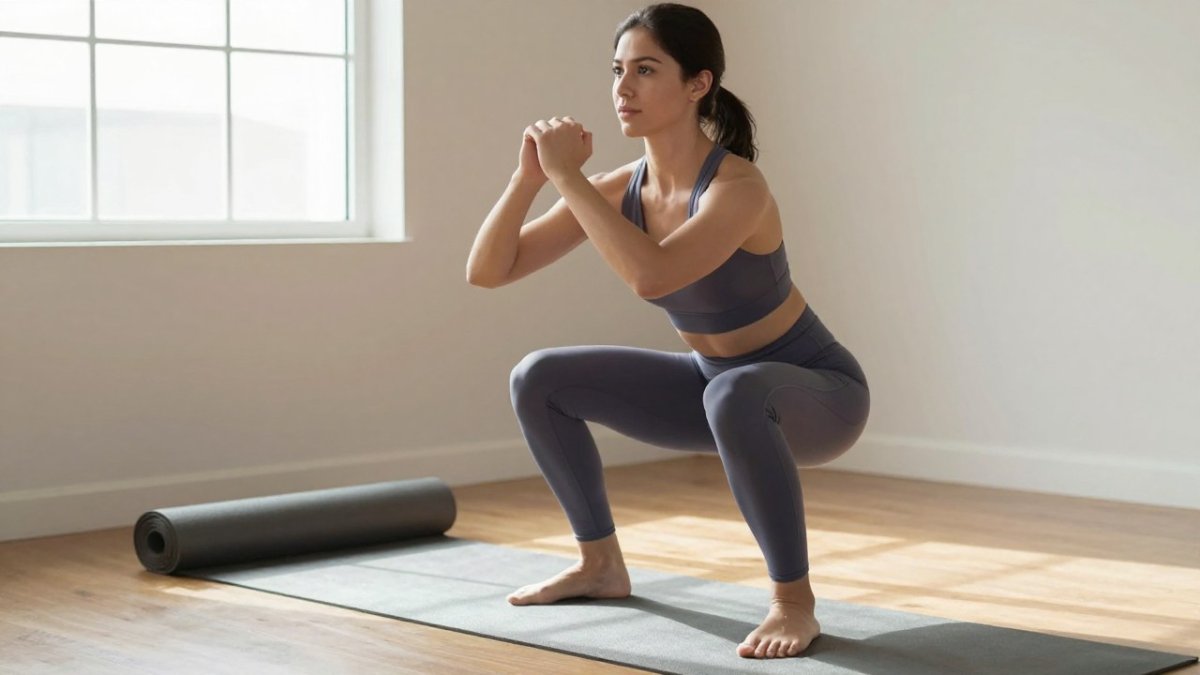
You can start with little or no gear. Bodyweight exercises such as squats, reverse lunges, push-ups, mountain climbers, and jumping jacks work several major muscle groups, and most have lower-impact versions. Pairing each exercise with a joint-friendly option and an easier regression lets you build a circuit at your current ability.
| Exercise | Standard Version | Low-Impact Option | Easier Regression |
|---|---|---|---|
| Squat | Bodyweight squat | Sit-to-stand from a chair | Squat to a high chair with arm support |
| Lunge | Reverse lunge | Step-back lunge without jumping | Split squat holding a countertop |
| Push-up | Full push-up | Incline push-up on a counter | Wall push-up |
| Mountain climber | Fast knee drives | Slow knee drives with hands on a chair | Standing knee drives |
| Jumping jack | Standard jumping jack | Step-out jack (one foot at a time) | Seated arm raises with marching |
Try this 12-minute circuit: 30 seconds of squats, 30 seconds of rest, 30 seconds of modified push-ups, 30 seconds of rest, then repeat with reverse lunges and knee drives. Three rounds is a full session. If any round feels like a 8 out of 10 or higher, drop to the easier regression for the next round rather than pushing through.
A common pattern among beginners is to pick the hardest version of each move on day one and then need four days to recover. Start with the low-impact column for the first two sessions, then advance one exercise at a time.
If you want gentler options first, our trainers point beginners toward these low-impact HIIT exercises you can do at home before adding jumps.
High Intensity Workouts for Beginners 2026 at Home
A home session works best when it is short, timed, and calibrated to an effort level you can actually judge. Set a timer, clear a space the size of a yoga mat, and pick four movements you can do with good form.
Warm up for three to five minutes with marching in place and arm circles. Then run three rounds of 30 seconds on, 30 seconds off. Cool down with slow walking and gentle stretching for three minutes.
Watch out: skipping the warm-up to save time is the most common beginner mistake we see, and it is the fastest route to a tweaked knee or a strained lower back.
How to Judge Effort at Home
High intensity does not mean all-out. Use the talk test: at the top of each work interval you should be able to speak a short sentence but not hold a conversation. On a 1-to-10 perceived exertion scale, beginners should land at 6 or 7 during work intervals and 3 or 4 during rest. If you cannot say three or four words at the peak, you are working above your current level and should slow down or extend the rest interval. Keeping the effort controlled makes the work-and-rest pattern easier to repeat, and The Running Bug can help you connect that rhythm with the broader principles of interval training.
A simple pattern is to check effort halfway through round one. If you are already at an 8, cut the work interval to 20 seconds for the rest of the session rather than abandoning the workout.
Safety Screening Before You Start
Before your first at-home session, run through a short screen. Stop and seek clinician advice if you have chest pain, dizziness, or unusual shortness of breath at rest or with light activity; if you have a known heart condition, uncontrolled blood pressure, or a recent joint injury; or if you are pregnant and have not discussed exercise with your provider. During a session, stop immediately for chest pressure, lightheadedness, sharp joint pain, or a heartbeat that does not settle during rest.
Recovery and Rest Days
Schedule at least one full rest day between HIIT sessions. Expect muscle soreness in the 24 to 48 hours after a new routine; that is normal. Soreness that lasts beyond 48 hours, pain that is sharp or one-sided, or fatigue that makes a normal day feel hard are signals to repeat the previous week rather than advance. Sleep and hydration do more for recovery than any supplement, and a common pattern is for beginners to add sessions faster than they add rest.
Tracking Progress Beyond Calorie Burn
Skip the calorie-burn readout as your main measure. Track four things instead: how many sessions you completed each week, your perceived effort at the end of round one, how many work intervals you finished with good form, and how you felt the morning after. Improvement in those four measures is a better sign of progress than any single workout's calorie estimate.
How Long Should Beginners Do HIIT?
Beginners should do HIIT for 15 to 25 minutes per session, including warm-up and cool-down, two times per week to start. The high-intensity portion itself is often only 8 to 12 minutes of that total.
One 1st Phorm beginner guide recommends exactly this 15-to-25-minute window and separates the intense portion from the full session length, which is a distinction most newcomers miss. A 2026 study in Nature Communications found that once- and thrice-weekly interval training was associated with reductions in adiposity and improvements in cardiorespiratory fitness among adults with central obesity (Nature Communications interval training study). Twice a week sits comfortably in the middle.
If pacing worries you, this guide on how to pace yourself in workouts walks through the seven steps we teach in class.
HIIT Workouts for Beginners Over 50
Older beginners should prioritize recovery and joint-friendly movements over speed. Research reported by ScienceDaily on interval training in older adults suggests interval-style training may help older adults lose body fat while retaining muscle, which makes it a reasonable option when scaled properly.
Swap jumping jacks for step-outs, burpees for squats to a chair, and mountain climbers for slow knee drives. Keep rest intervals long, and stop a round while you still feel you could do two more.
Our take on doing kickboxing at your own pace explains how to work at a level that suits you rather than matching the room.
A Four-Week Progression Plan With Effort Guidance and Recovery Days
Progress comes from adding rounds, not from adding speed. Use a simple effort scale: a 6 out of 10 should feel hard but sustainable, and you should be able to speak a short sentence at the top of each work interval.
| Week | Sessions | Work / Rest | Rounds | Effort Target |
|---|---|---|---|---|
| 1 | 2 | 20 sec / 60 sec | 4 | 5-6 of 10 |
| 2 | 2 | 30 sec / 60 sec | 4 | 6 of 10 |
| 3 | 3 | 30 sec / 45 sec | 5 | 6-7 of 10 |
| 4 | 3 | 40 sec / 40 sec | 5 | 7 of 10 |
Schedule at least one full rest day between sessions, and treat soreness that lasts beyond 48 hours as a signal to repeat the previous week rather than advance. For a deeper look at why the format works, read our breakdown of high intensity interval training benefits.
Book Your Free Kickboxing Class at CKO
Guided intervals can help beginners, because someone else handles the timing and the form cues. Our classes feature real heavy bags, energizing music, and a format you can scale to your own pace.
See our fitness kickboxing classes in Bayonne and book your free first session.
Starting is the hardest round you will ever do. If you have been waiting for the right moment to try high intensity workouts, let this be it. CKO Kickboxing gives you real heavy bags, a supportive community, and the freedom to move at your own pace while our instructors handle the rest. Get started with CKO Kickboxing and book your free class today.
Frequently Asked Questions
What are some good high intensity workouts for beginners?
Start with bodyweight circuits that use movements you already know: squats, reverse lunges, marching in place, and modified push-ups. A simple format is 30 seconds of work followed by 30 seconds of rest, repeated for 15 movements. The goal in week one is finishing the session with good form, not collapsing at the end.
How long should beginners do HIIT?
A typical beginner session runs 15 to 25 minutes including warm-up and cool-down, according to 1st Phorm. The high-intensity portion itself is often only 8 to 12 minutes. Start with two rounds of a short circuit and add a round each week as you adapt. If you cannot hold conversation for the first minute of rest, the work interval was too long or too hard.
Can beginners do high intensity workouts at home without equipment?
Yes. Bodyweight movements like squats, sumo squats, mountain climbers, jumping jacks, and knee drives need no equipment at all. Clear a 6-foot by 6-foot space, wear supportive shoes, and keep water nearby. If jumping bothers your joints, swap jumps for step-backs or marching in place.
Is HIIT suitable for beginners over 50?
It can be, with adjustments. Some research suggests interval-style training may help older adults manage body composition. Choose low-impact versions of each move, extend rest intervals to 60 seconds, and keep sessions to 15 minutes at first. Anyone with heart, joint, or blood pressure concerns should check with a doctor before starting.
What should a beginner do before and after a HIIT workout?
Spend 5 minutes warming up with marching in place, arm circles, and slow bodyweight squats to raise your heart rate gradually. After the workout, cool down for 5 minutes with walking and static stretches for your legs, hips, and shoulders. Drink water, and expect soreness for 24 to 48 hours. Schedule at least one full rest day between sessions while you build a base.
