CKO Bayonne
7 Steps to Start Kickboxing for Weight Loss
Last Updated: November 2, 2026
Quick Summary
To start kickboxing for weight loss, set a realistic goal, get a checkup, and master form before adding speed. Train 30 to 45 minutes three times a week, building up over four to six weeks, and track progress beyond the scale.
- Kickboxing combines cardio and strength training in one session to burn calories while building muscle.
- A five-week kickboxing study found body-fat percentage did not drop in the kickboxing group.
- Beginners should train 30 to 45 minutes, three times a week, to build stamina without wrecking recovery.
- Add 5 minutes to a session only when you finish the previous week without joint pain or lingering soreness.
- Never increase weekly duration by more than about 10 to 15 percent.
Table of Contents
- Kickboxing for Weight Loss for Beginners: Why It Burns Calories
- Step 1: Set a Realistic Goal and Get a Checkup First
- Step 2: Choose Your Format, Class or Kickboxing for Weight Loss at Home
- Step 3: Master Form and Technique Before You Add Speed
- Step 4: Follow a Full Body Kickboxing Workout Routine
- Step 5: Get the Kickboxing Workout Duration for Beginners Right
- Step 6: Build Consistency With Three Sessions per Week
- Step 7: Track Progress and Fuel Your Training
- Frequently Asked Questions
Kickboxing for Weight Loss for Beginners: Why It Burns Calories
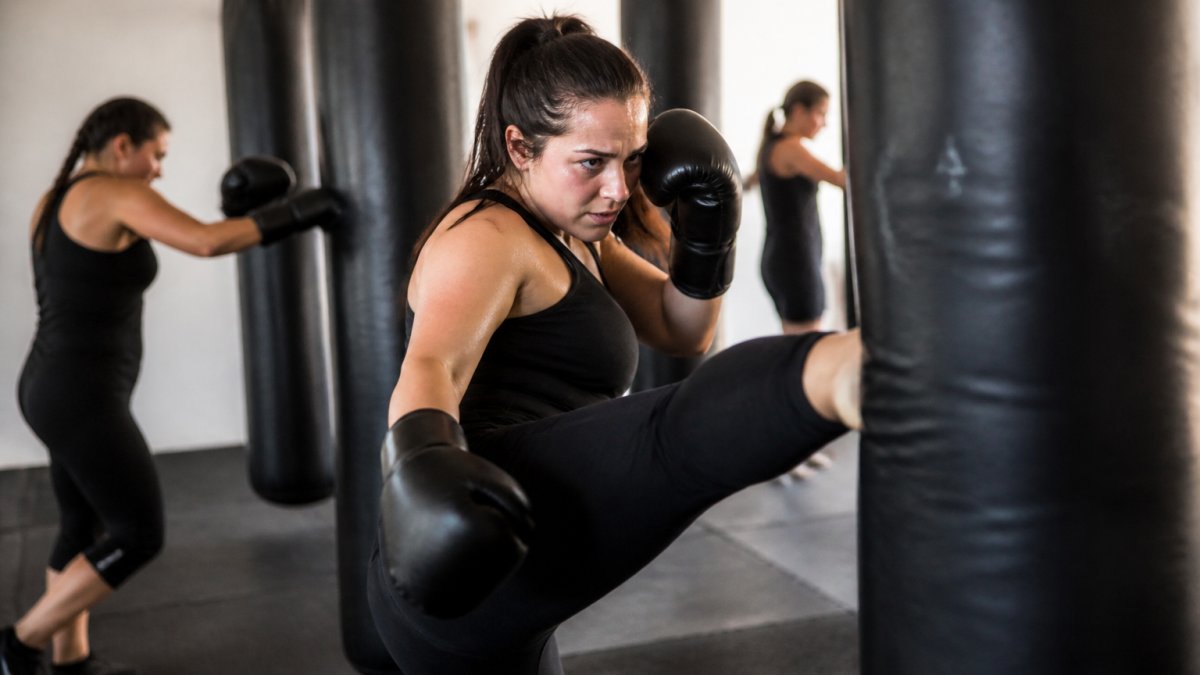
Kickboxing for weight loss works because it combines cardio and strength training in one session. You throw punches and kicks, move your feet, and keep your heart rate up. That mix burns calories while you build muscle.
Many beginners find that heavy bags, energizing music and an energetic room make the work feel less like a chore.
Below, we'll walk you through how to start, week by week, at a pace that keeps injury and burnout in check.
What the Research Says About Fat Loss
The science is honest, and that's a good thing. A randomized study on five weeks of kickboxing training found that body-fat percentage did not drop in the kickboxing group over that short period. Researchers led by I. Ouergui published those results in 2014.
So what does that mean for you?
- Kickboxing burns calories, but short bursts alone don't guarantee fat loss
- Body composition changes take time and consistency
- Your eating habits matter as much as your workouts
Think of kickboxing as one useful tool in your toolbox alongside other healthy habits.
Step 1: Set a Realistic Goal and Get a Checkup First
Kickboxing for weight loss for beginners starts with a clear, honest goal. Pick a target you can measure, like a weekly class count or a clothing fit, not just a number on the scale.
Before your first session, check in with your doctor. This matters if you have heart issues, joint problems, or you've been inactive for a while.
Then write down three things:
- Your goal and a realistic date
- How many days a week you can train
- What you'll change in your eating
Small, specific goals beat vague ones every time.
Step 2: Choose Your Format, Class or Kickboxing for Weight Loss at Home
You have two main paths, and both work. A class can give you coaching, equipment, and group energy. A home routine can give you flexibility and privacy.
Here's how they compare:
| Factor | In-Person Class | Home Workout |
|---|---|---|
| Coaching | Instructor corrects your form | You self-check with mirrors or video |
| Equipment | Real heavy bags provided | Bag or shadowboxing needed |
| Cost | Monthly membership or class packs | Low, mostly one-time gear |
| Motivation | Group energy pushes you | Relies on self-discipline |
| Best for | Beginners who want guidance | Busy schedules and solo training |
If you want to see what a class looks like, explore our kickboxing classes. Ready to try one? You can find a CKO Kickboxing location near you.
For current pricing, check the CKO Kickboxing pricing page on our website.
Step 3: Master Form and Technique Before You Add Speed
Speed comes last. Form comes first. A sloppy punch with power behind it is how wrists and shoulders get hurt.
Start with these basics:
- Stance: feet shoulder-width, one foot forward, knees soft
- Guard: hands up near your cheeks, elbows tucked
- Punches: rotate your hips, extend, snap back to guard
- Kicks: pivot on your base foot, strike with the shin or ball of the foot
- Breathing: exhale on every strike
A common mistake is swinging with your arms only. Power starts in your legs and core, then travels through your hips. Slow down until the motion feels natural. Add speed once your form holds under fatigue.
Step 4: Follow a Full Body Kickboxing Workout Routine
A full body kickboxing workout routine hits every major muscle group. Once this weekly pattern feels manageable, lifting weights at home can add another way to build strength without changing the habit of showing up.
Here is a four-week progressive structure that builds from short and simple to longer and more intense. Each week has three training days and at least one full rest day between hard sessions.
| Week | Monday | Wednesday | Saturday | Weekly Total |
|---|---|---|---|---|
| 1 | 20-min technique session | 20-min technique session | 25-min light intervals | 65 min |
| 2 | 25-min technique session | 25-min technique plus core | 30-min intervals | 80 min |
| 3 | 30-min full-body session | 25-min technique plus core | 35-min intervals | 90 min |
| 4 | 35-min full-body session | 30-min technique plus core | 40-min intervals | 105 min |
Progression rules:
- Add 5 minutes to a session only when you finish the previous week without joint pain or lingering soreness.
- Keep at least one full rest day between high-intensity days.
- If you miss a session, repeat the previous week rather than jumping ahead.
- Never increase weekly duration by more than about 10 to 15 percent.
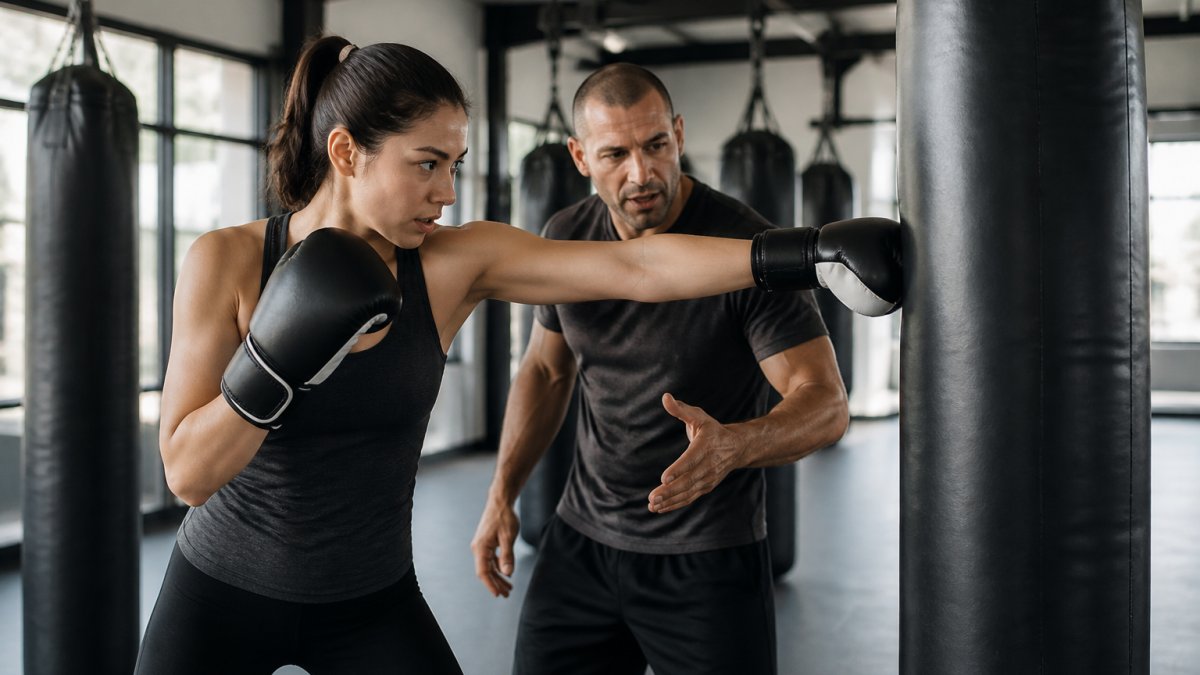
A Complete 30-Minute Beginner Session With Technique Cues
Use this session at home or as a pre-class warm-up. It follows a warm-up, skill block, conditioning block, and cool-down.
Warm-up (5 minutes)
- Jog in place, 1 minute
- Arm circles forward and back, 30 seconds each direction
- Leg swings front-to-back and side-to-side, 30 seconds each leg
- Bodyweight squats, 10 reps
- Shadowboxing at half speed, 1 minute
Skill block: punches (8 minutes)
- Stance check: feet shoulder-width, one foot forward, knees soft, hands at cheek height.
- Jab-cross, 2 minutes. Cue: rotate the rear hip and pivot the rear heel on the cross.
- Jab-cross-hook, 2 minutes. Cue: keep the non-punching hand glued to your cheek.
- Rest 30 seconds.
- Repeat the two combinations for another 3 minutes at a slightly faster pace.
Skill block: kicks (7 minutes)
- Front kick, 2 minutes each leg. Cue: lift the knee first, then extend, and strike with the ball of the foot.
- Roundhouse kick, 2 minutes each leg. Cue: pivot on the base foot and turn the hip over; strike with the shin, not the toes.
- Rest 30 seconds between legs.
Conditioning block (5 minutes)
- 30 seconds of fast punches on a bag or in the air
- 30 seconds of rest
- Repeat five times
Core finisher (3 minutes)
- Plank, 30 seconds
- Bicycle crunches, 30 seconds
- Repeat three times
Cool-down (2 minutes)
- Stretch hips, shoulders, and calves, holding each stretch about 20 seconds.
Keep intensity moderate. You should be able to talk in short sentences. If you cannot, slow down.
Watch out: skipping the warm-up or throwing full-power punches before your form is set is the most common cause of wrist and shoulder strain in the first month.
Step 5: Get the Kickboxing Workout Duration for Beginners Right
The right kickboxing workout duration for beginners is 30 to 45 minutes, three times a week. That's enough to build stamina without wrecking your recovery.
Start shorter than you think you should. A 15-minute session you finish beats a 60-minute session you dread.
Watch out: jumping into hour-long classes in week one is the fastest route to sore joints and skipped workouts. Build up over four to six weeks.
Signs you're overdoing it include:
- Persistent soreness that lasts more than two days
- Trouble sleeping or feeling wiped out
- Nagging joint pain
If any of these show up, scale back and rest.
Step 6: Build Consistency With Three Sessions per Week
Three sessions per week is the sweet spot for most beginners. It gives you enough training to see progress while leaving room to recover.
Consistency beats intensity. A person who trains three times a week for months will outperform someone who goes all-out for two weeks and quits.
Our group fitness classes are high-energy sessions with a supportive community.
Tips to stay consistent:
- Schedule classes like appointments
- Pick the same days each week
- Bring a friend or make one in class
- Track your sessions on a calendar
Step 7: Track Progress and Fuel Your Training
What gets measured gets managed, but the scale alone is a poor coach. Weight can stall for weeks while your body composition, stamina, and sleep improve. The honest approach is to track several measures and give the process enough time to show a trend.
Realistic Weight-Loss Expectations
Weight loss depends on overall energy balance: the calories you take in versus the calories you burn (the CDC). Kickboxing adds to the calories you burn, but it does not override a large calorie surplus. Results vary widely based on starting weight, diet, sleep, stress, and how much you move outside class.
A reasonable target is a slow, steady trend rather than a fixed number. A slow, steady weekly loss is generally considered a sustainable pace, though individual results differ (the CDC).
How to Track Progress
Track these instead of relying on the scale alone:
- Weekly average weight: weigh yourself at the same time a few days a week and average the numbers. Daily fluctuations are normal and mostly water.
- Waist measurement: measure at the same spot once every two weeks.
- Clothing fit: note how a specific pair of pants fits at the start and again each month.
- Class performance: record rounds completed, combinations learned, or how long you can keep a moderate pace.
- Energy and sleep: rate them 1 to 5 each week.
- Session log: write down date, duration, and intensity so you can see consistency at a glance.
A simple habit tracker on paper or a phone app works fine. The goal is a monthly review, not daily obsession.
Fuel Your Training Without Overthinking It
- Eat a source of protein with each meal, such as eggs, chicken, fish, beans, or Greek yogurt.
- Drink water before and after training; even mild dehydration makes a session feel harder.
- Consider a small snack with carbohydrate and protein before class if you train on a near-empty stomach.
- Keep alcohol and sugary drinks occasional; they add calories without helping recovery.
- Aim for consistent sleep, since poor sleep can increase hunger and reduce training quality.
Small, steady changes to eating stick better than strict diets. If you want professional nutrition guidance, a registered dietitian can tailor a plan to your needs.
Read our member stories to see how others started where you are now.
Frequently Asked Questions
Can kickboxing help with weight loss?
Kickboxing can support weight loss because it is a high-energy cardio and full-body workout that burns calories and builds strength. A five-week study found body-fat percentage did not decrease in the kickboxing group, so treat it as one part of a plan that includes healthy eating and consistency. Aim for three sessions per week and track your progress over months, not weeks.
How often should a beginner do kickboxing for weight loss?
Start with two or three sessions per week and leave at least one rest day between them. The three sessions per week mark is a common target once your body adjusts. Keep each session to 30-45 minutes at first, including a warm-up. Consistency matters more than intensity, so pick a schedule you can repeat and build from there.
Can I start kickboxing at home as a beginner?
Yes. A home workout needs open floor space, athletic shoes, and optional gloves or a heavy bag. Begin with 15-30 minute sessions focused on punches, kicks, and bodyweight drills. Home training works well for learning basics, but a class gives you form feedback and a set schedule. Many beginners combine both: home sessions for practice and a class for coaching.
What should I bring to my first kickboxing class?
Bring water, a towel, and comfortable athletic clothing you can move in. Wear supportive shoes unless the class trains barefoot. Arrive 10-15 minutes early to meet the instructor and mention you are new so they can offer modifications. A free trial class is the easiest way to see the format before committing.
Starting a new routine takes courage, and doing it alone makes it harder. At CKO Kickboxing, you get real heavy bags, energizing music, and a supportive community that moves at your own pace. Our classes combine cardio and strength work to help you burn calories and relieve stress. Get started with CKO Kickboxing and book your free class today.
