CKO Bayonne
Kickboxing Gloves for Home Workouts: A Buyer's Guide
Last Updated: November 19, 2026
Quick Summary
Kickboxing gloves are padded training mitts that cover the knuckles and wrist to absorb impact during bag work and pad drills. For most adults, the best weight for heavy bag gloves is 14 to 16 ounces, with 14oz widely considered the best all-round choice for home workouts.
- Standard training glove weights are 12, 14, and 16 ounces.
- Measure around the dominant hand at the widest point across the knuckles, thumb excluded.
- Hand wraps take about a minute to apply and are commonly worn under gloves.
- Genuine leather lasts longer and breathes better, while synthetic leather costs less and cleans easily.
- A 30-minute session includes a 5-minute warm-up, six 3-minute rounds, and a 5-minute cool-down.
Table of Contents
- Why Kickboxing Gloves Matter for Home Workouts
- The Best Weight for Heavy Bag Gloves
- How to Wrap Hands for Kickboxing
- Synthetic vs. Leather: Which Glove Material Lasts
- Top Kickboxing Gloves for Home Workouts Compared
- A Full Body Kickboxing Workout Routine at Home
- Small Space Setup and Wearable Tracker Integration
- Book a Free Class and Test Your Gloves on Real Heavy Bags
- Frequently Asked Questions
Why Kickboxing Gloves Matter for Home Workouts
The global boxing gloves market is valued at USD 1.72 billion in 2026, according to Coherent Market Insights' market valuation, and home fitness is driving much of that growth. If you are building a home training setup, kickboxing gloves are the one piece of gear that protects your hands and wrists on every punch.
Kickboxing gloves are padded training mitts that cover the knuckles and wrist to absorb impact during bag work and pad drills. Multi-layer foam padding absorbs shock and helps minimize microtrauma to the hands during heavy bag workouts, according to Exercise Daily's glove guide. Home-based boxing training has also been shown to improve trunk performance, balance, and balance confidence, per a 2023 study in the NCBI database.
The Best Weight for Heavy Bag Gloves
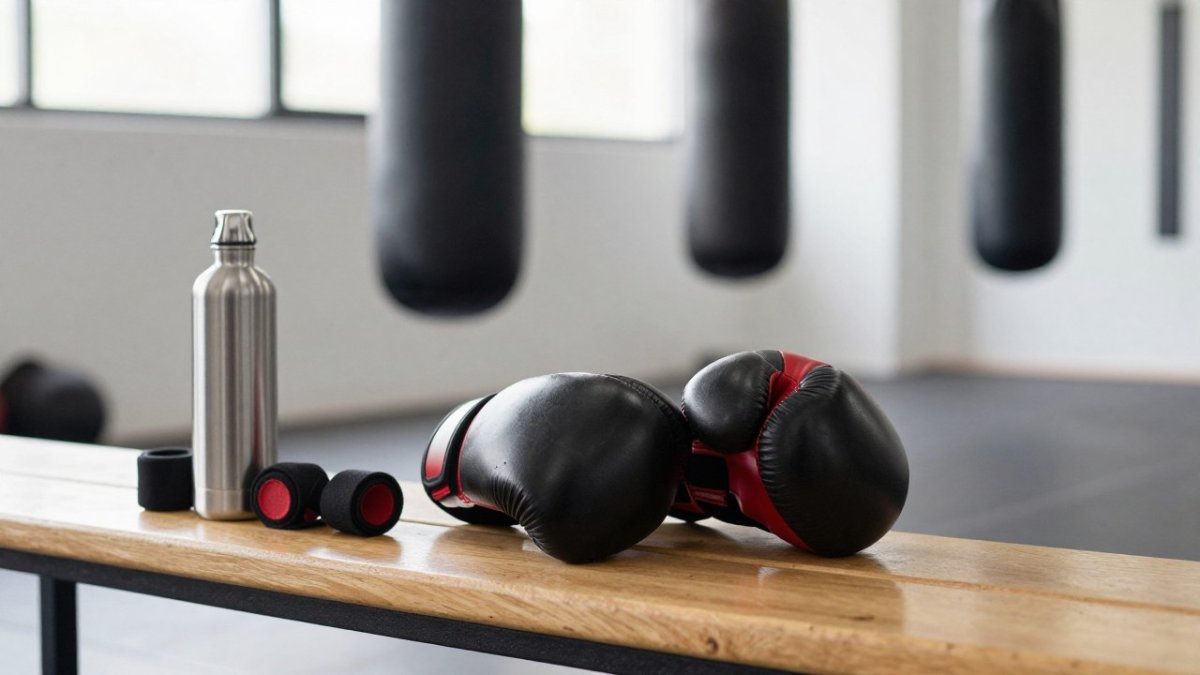
The best weight for heavy bag gloves is 14 to 16 ounces for most adults. A 14oz glove is widely considered the best all-round choice for home workouts, offering protection for bag work while staying manageable for pad work, per Pro Fight Store's sizing guide. Standard training weights are 12, 14, and 16 ounces, per FightCamp's equipment standards.
Matching Glove Weight to Your Body Weight and Training
Use this as a starting point, then adjust for how your hands feel:
| Glove Weight | Best For | Typical User |
|---|---|---|
| 12 oz | Speed work, pad drills, cardio kickboxing | Adults under 130 lb |
| 14 oz | All-round bag work and pad work | Most adults, 130-175 lb |
| 16 oz | Heavy bag power work, extra knuckle protection | Adults over 175 lb |
Lighter gloves build speed; heavier gloves add shock absorption and wrist support for hard bag sessions. If you are new to kickboxing, start at 14oz and move up only if your knuckles feel tender after training.
Sizing by Hand Circumference, Not Just Body Weight
Ounces tell you how much padding a glove has, not whether it fits your hand. For online buyers, fit matters more. Measure around the dominant hand at the widest point across the knuckles, thumb excluded, with a soft tape. Manufacturer hand-circumference ranges overlap, so two people at 150 lb can land in different gloves.
As a general starting point, many people use the following guide:
| Hand Circumference | Starting Glove Size | Notes |
|---|---|---|
| Under 7 in | 10-12 oz youth or small | Check youth sizing before buying adult 12oz |
| 7-8 in | 12 oz | Fits most smaller adult hands |
| 8-9 in | 14 oz | The most common adult fit |
| 9-10 in | 16 oz | Roomier hand compartment |
| Over 10 in | 16 oz or larger | Confirm thumb and palm depth with the seller |
Fit problems show up in specific ways. A glove that is too small pinches the thumb web and limits how tightly you can close your fist, pushing you to punch with an open hand.
Wrist Closure and Padding Density
Ounce weight is only half the spec sheet. Hook-and-loop straps are the home-workout standard because you can tighten them alone; lace-up gloves give a more locked-in fit but need a partner or a lace converter. Padding density matters too: a 16oz glove with soft, low-density foam can bottom out on a hard bag faster than a 14oz glove with firmer layered foam.
When to Move Up or Down an Ounce
Treat the table as a starting point and adjust after two weeks. Move up one size if your knuckles or wrist feel tender the morning after bag work, if you are doing mostly power rounds, or if you are over 175 lb and hitting hard. Move down one size if the gloves feel bulky on pad drills, if your hands overheat quickly, or if you are doing mostly speed and cardio work. Beginners should not buy 16oz "to be safe", oversized gloves teach sloppy fist formation and slow down proper technique.
How to Wrap Hands for Kickboxing
Hand wraps are the first layer of wrist support and knuckle protection, and they take about a minute to apply. Here is how to wrap hands for kickboxing in five steps:
- Loop the thumb strap and anchor the wrap at the wrist.
- Wrap around the wrist three times for joint stability.
- Cross over the back of the hand toward the knuckles.
- Wrap between each finger to separate and protect them.
- Finish with two passes over the knuckles and secure the hook-and-loop closure.
Hand wraps are commonly worn under gloves to support the wrist and hand during bag work.
Synthetic vs. Leather: Which Glove Material Lasts
Genuine leather lasts longer and breathes better; synthetic leather costs less and cleans easily. Leather molds to your hand over time and resists cracking, which is why premium gloves use it. Synthetic leather, usually polyurethane or vinyl, wipes clean and holds up well in a home gym, though it traps heat more than leather.
One trade-off worth knowing: research in a 2019 ResearchGate study on sports gloves indicates that wearing gloves can reduce finger tactile sensitivity and grip strength. That is a reason to keep gloves off for warm-ups and bodyweight exercises, not a reason to skip them.
Top Kickboxing Gloves for Home Workouts Compared
We compared six gloves across price, padding, and who each suits.
| Glove | Price | Best For | Watch Out For |
|---|---|---|---|
| Hawk Sports | $19.99 | Budget beginners | Thinner padding, faster wear |
| Everlast Pro Style | $35.00 | General cardio classes | Foam breaks down sooner |
| Century Strive | $45.00 | Heavy bag training | Vinyl is less breathable |
| Sanabul Gold Strike | $69.99 | Beginners to intermediate | Fewer color options |
| Winning Training | $300.00 | Serious protection seekers | High price, stock waits |
Price
Budget and Mid-Range Picks
Sanabul Gold Strike Boxing Gloves ($69.99) punch above their price with engineered leather construction and a mesh palm panel. They are highly rated for wrist support, with limited color options as the main drawback.
Premium Picks for Serious Trainers
Best for: daily heavy bag trainers who want maximum knuckle protection. Skip if: you are still deciding whether home training will stick.
A Full Body Kickboxing Workout Routine at Home
A full body kickboxing workout routine at home needs no more than gloves, wraps, and a bag or open floor. Structure a 30-minute session like this:
- Warm-up (5 min): jumping jacks, arm circles, hip rotations
- Rounds (20 min): six 3-minute rounds with 1-minute active recovery, alternating jab-cross combos, hooks, and kicks
- Cool-down (5 min): walking, shoulder and hip stretches
Boxing exercises are increasingly popular for home fitness because high-intensity training burns calories and builds muscular tone, per Fortune Business Insights' market analysis. For a ready-made session, follow our full body kickboxing workout routine. If weight loss is the goal, our 7 steps to start kickboxing for weight loss maps out the beginner path.
Small Space Setup and Wearable Tracker Integration
Small spaces work fine for bag work if you plan the layout around the punch, not around the bag. The constraint is rarely floor area for the bag itself; it is the swing path your arm and the bag's sway need. A freestanding bag needs roughly a 5-foot circle of clearance, and shadowboxing needs only enough room to extend your arms. Most practitioners find that a 6-by-6-foot open patch of floor handles shadowboxing, footwork, and bodyweight intervals, while a heavy bag on a stand needs closer to 8-by-8 feet once you account for the bag's sway on hard hooks.
Layout Rules for Apartments and Shared Rooms
Place the bag so its sway runs along the longest open axis, not toward a wall or a doorway. A bag that swings into a wall on every hook forces you to pull punches, which builds bad habits. Keep at least 3 feet of clear floor behind the bag for footwork and at least 2 feet on each side for angling out after combinations.
Noise and vibration are the real apartment problems, not space. A freestanding bag with a water or sand base transmits less impact noise than a ceiling-mounted heavy bag, and a rubber mat under the base cuts vibration into the floor below.
Storage and Hygiene Between Sessions
Gloves and wraps trap moisture, and a small space traps that moisture with them. Wipe the inside of synthetic gloves with a mild disinfectant and let them dry fully before the next round. Leather gloves should be wiped, not soaked, and conditioned occasionally to keep the shell from cracking.
Using Wearable Trackers With Home Rounds
Wearable trackers are becoming part of the setup. The smart boxing gloves market is projected to grow from USD 186.36 million in 2026, per Fortune Business Insights' smart glove data, and many trainers now log rounds on a watch or ring.
A practical pattern is to log each 3-minute round as a work interval and each 1-minute recovery as rest, then compare average heart rate across rounds week to week. If your work-interval heart rate is climbing at the same combo pace, you are either fatiguing or working harder; if it is flat while your punch count rises, your conditioning is improving.
Book a Free Class and Test Your Gloves on Real Heavy Bags
The fastest way to know a glove fits is to hit a real bag with it. At CKO Kickboxing, our classes use real heavy bags, not air, so you can feel how padding density and wrist support behave on impact.
Want to see the payoff before you invest? Read 8 benefits of heavy bag workouts.
Your hands take every punch you throw, and the wrong glove turns a good workout into sore knuckles and stalled progress. CKO Kickboxing gives you real heavy bags, a motivating community, and classes you can take at your own pace, so you can test gear and technique together.
Frequently Asked Questions
What weight kickboxing gloves should a beginner buy for home workouts?
Many beginners find 14 oz gloves a practical all-round choice for home training. That weight gives enough padding for heavy bag work while staying light enough for pad drills and shadowboxing. If you weigh under 120 pounds or plan mostly cardio kickboxing, 12 oz gloves are a reasonable start. If you weigh over 180 pounds or hit the bag hard, move up to 16 oz gloves for better knuckle protection.
Do I need hand wraps if I already wear kickboxing gloves?
Yes. Gloves protect the knuckles, but hand wraps stabilize the small bones of the wrist and hand during repeated impact. Hand wraps cover the knuckles, the back of the hand, and the wrist. Wrap snugly but not tight enough to cut off circulation, and check that your fingers still move freely. Wraps also absorb sweat, which keeps the inside of your gloves drier between sessions.
Can I use kickboxing gloves for sparring as well as bag work?
Training gloves built for bag work are not sparring gloves. Bag gloves use denser foam to absorb impact, while sparring gloves use softer padding to protect a partner. Using stiff bag gloves in sparring raises the risk of injury to both people. If you plan to spar, buy a separate pair rated for it. For home workouts on a heavy bag, a 14 oz or 16 oz training glove is the right tool.
How often should I replace kickboxing gloves used at home?
Check the padding density every few months. Gloves used frequently on a heavy bag tend to wear out faster than gloves used lightly, so check them regularly. Warning signs include flattened knuckle foam, cracked synthetic leather, and a loose hook-and-loop closure that no longer holds the wrist firm. Air your gloves out after each session and wipe the lining to slow breakdown.
