CKO Bayonne
Kickboxing Workout for Core Strength That Actually Transfers
Last Updated: November 26, 2026
Quick Summary
A kickboxing workout builds core strength because every punch and kick starts in your midsection, training your core to brace, rotate, and stabilize under load instead of just holding still like crunches. Add six targeted moves such as plank punches and knee-to-elbow strikes to your rounds, and run three sessions per week.
- Crunches train one motion in one plane, while kickboxing trains bracing, twisting, and balance.
- Six moves include plank punch, table punch twist, roll-up punch, leg lift punch, torso twist punch, and knee-to-elbow strike.
- Beginners use 20 seconds work and 40 seconds rest; advanced use 40 seconds work and 20 seconds rest.
- Three sessions per week builds core endurance without overtraining.
- Rotate from the hips, not the waist, and exhale on every strike to protect your back.
Table of Contents
- Why a Kickboxing Workout Builds Core Strength Better Than Crunches
- Kickboxing Exercises for Abs and Obliques
- How to Structure a Kickboxing HIIT Workout
- Your 45 Minute Core Workout, Round by Round
- How to Do a Kick Boxing Workout at Home With Minimal Equipment
- Beginner Modifications and Technique Cues That Protect Your Back
- Tracking Progress: What to Measure Beyond the Mirror
- Book Your Free Class and Put the Rounds to Work
- Frequently Asked Questions
Why a Kickboxing Workout Builds Core Strength Better Than Crunches
A kickboxing workout for core strength works because every punch and kick starts in your midsection. In kickboxing classes, people who can hold a plank for two minutes often still wobble on their first hook.
Crunches train one motion, spinal flexion, in one plane. Research backs the training style: a systematic review on core strength training in striking combat sports found that core-strength work is linked to better technical performance in striking athletes.
A strong core is a core that transfers force, and kickboxing forces that transfer on every combination.
The Muscles Every Punch and Kick Recruits
Your core is more than abs. It includes the rectus abdominis, the obliques along your sides, the deep transversus abdominis, and the muscles of your lower back and hips.
Here is what fires during a simple cross:
- Obliques: rotate your torso and hips into the punch
- Transversus abdominis: braces your spine before impact
- Rectus abdominis: controls the forward lean
A jab alone asks your midsection to stop your torso from spinning off-balance. A kick asks for even more.
Kickboxing Exercises for Abs and Obliques
These six moves turn standard punches and kicks into targeted ab work. Add them to your rounds or do them as a circuit.
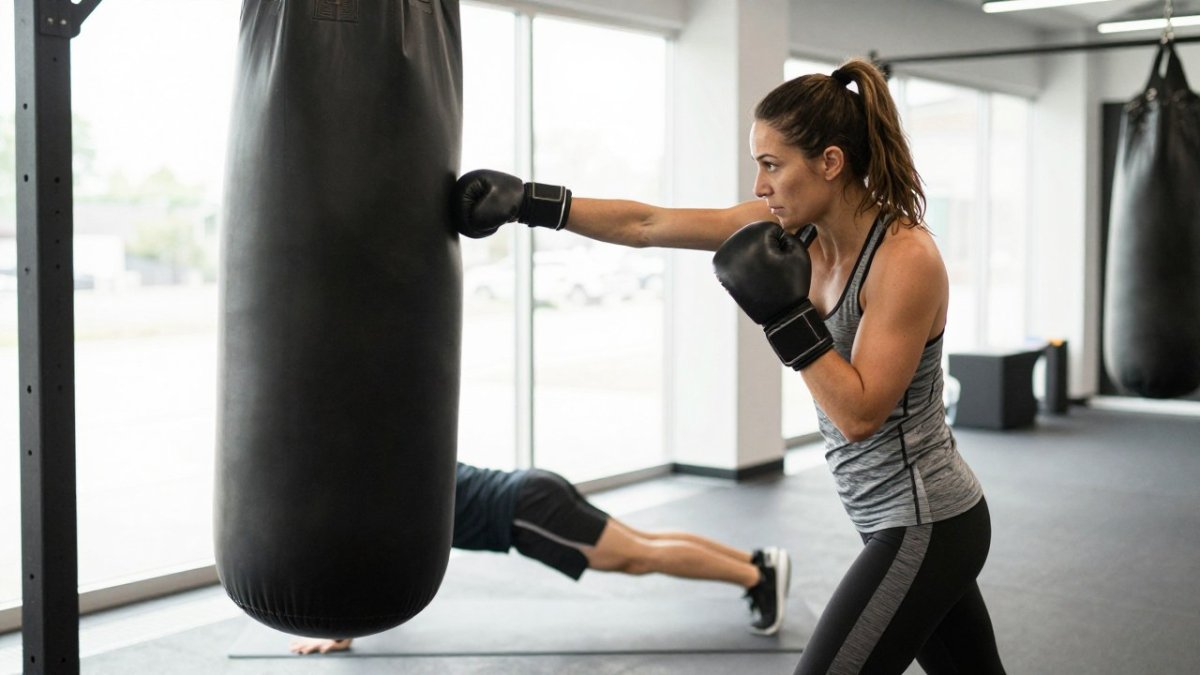
Six Moves to Add to Your Rounds
- Plank punch: Hold a push-up plank and punch forward one arm at a time. Your core fights the rotation.
- Table punch twist: From all fours, lift one knee and punch across your body. Great for obliques.
- Roll-up punch: Lie back, roll up to sitting while throwing a punch, then lower with control.
- Leg lift punch: Lie on your back, lift both legs, and tap a punch toward your toes.
- Standing torso twist punch: Feet planted, rotate through the hips and throw a hook. Slow it down to feel your obliques work.
- Knee-to-elbow strike: Drive one knee up while pulling the opposite elbow down. This one spikes your heart rate fast.
Want more moves beyond these six? Here is a full body kickboxing workout routine you can follow for 30 minutes.
How to Structure a Kickboxing HIIT Workout
A kickboxing HIIT workout alternates short bursts of hard striking with brief recovery, building cardio and core endurance because your abs stay braced through every fast round. A complete structure covers warm-up, timed rounds, rest periods, cooldown, and a repeatable weekly schedule.
40-Min Cardio Kickboxing & Dumbbell Core Workout
CHRISTINA DORNER
The Five-Part Session Template
Every session follows the same skeleton, whether you have 20 minutes or 45:
- Warm-up (5 minutes): jump rope or easy shadow boxing, arm circles, hip openers, and torso twists to raise your heart rate and wake up your midsection.
- Skill block (5 minutes): slow shadow boxing with one or two combinations, focusing on hip rotation and exhaling on each strike, so form is set before fatigue.
- HIIT rounds (15 to 25 minutes): timed work intervals with brief rest, alternating striking rounds with core-focused bodyweight rounds.
- Finisher (3 to 5 minutes): one short core circuit such as plank punch, table punch twist, and knee-to-elbow strikes, done for quality rather than speed.
- Cooldown (5 minutes): slow stretches for hips, shoulders, and lower back, plus deep breathing.
Work-to-Rest Ratios by Fitness Level
Use a ratio that matches your current conditioning, not your ambition:
- Beginners: 20 seconds work, 40 seconds rest
- Intermediate: 30 seconds work, 30 seconds rest
- Advanced: 40 seconds work, 20 seconds rest
A common pattern is to run four to six rounds per block, then rest 60 to 90 seconds between blocks. If your form breaks down before the work interval ends, shorten the interval rather than pushing through sloppy reps.
Tabata is the shortest version: 20 seconds all-out, 10 seconds rest, eight rounds. It is intense, so save it for one block, not the whole session. ACSM's fitness trends guidance notes that interval-style classes remain a top trend, which tracks with what we see in class.
A Repeatable 30-Minute HIIT Session
Here is a complete session you can run at home or in class:
| Segment | Time | What You Do | Core Focus |
|---|---|---|---|
| Warm-up | 5 min | Jump rope, arm circles, hip openers, torso twists | Wake up the midsection |
| Skill block | 5 min | Slow jab-cross-hook and front-kick practice | Hip rotation and bracing |
| HIIT block 1 | 8 min | Four rounds of 30/30: jab-cross-hook combos | Rotation and bracing |
| HIIT block 2 | 8 min | Four rounds of 30/30: front kicks and roundhouse kicks | Hip rotation and balance |
| Finisher | 3 min | Plank punch, table punch twist, knee-to-elbow strikes | Direct ab and oblique work |
| Cooldown | 5 min | Slow stretches and deep breathing | Recovery |
Time
Rest 60 seconds between blocks.
Weekly Schedule
Three sessions per week is enough to build core endurance without overtraining:
- Monday: 30-minute HIIT session as above
- Wednesday: 20-minute session with two HIIT blocks and a longer finisher
- Friday: 30-minute session, swapping in different striking combinations
On off days, walk or do light mobility work. Keep your heart rate steady through rest periods by breathing through your nose, and do not stop moving completely between rounds.
Watch out: if your lower back arches during kicks or your punches get sloppy in the last 10 seconds of a round, end the round early and reset your brace.
Your 45 Minute Core Workout, Round by Round
Here is a complete, repeatable 45 minute core workout you can run at home or in class. Warm up first, then work through five blocks.
| Block | Time | What You Do | Core Focus |
|---|---|---|---|
| Warm-up | 5 min | Jump rope, arm circles, hip openers | Wake up the midsection |
| Round 1 | 8 min | Jab-cross-hook combos, 30/30 intervals | Rotation and bracing |
| Round 2 | 8 min | Front kicks and roundhouse kicks | Hip rotation and balance |
| Round 3 | 8 min | Plank punch, table punch twist, roll-up punch | Direct ab and oblique work |
| Round 4 | 8 min | Kick-punch-knee combinations | Full-body core endurance |
| Cooldown | 8 min | Slow stretches, deep breathing | Recovery |
Rest 60 seconds between rounds. If you have less time, cut Rounds 3 and 4 and keep the warm-up.
How to Do a Kick Boxing Workout at Home With Minimal Equipment
You can run a kick boxing workout at home with almost nothing. Bodyweight exercises, a clear floor space, and a mat cover most of it.
Here is what helps:
- A mat: for plank and floor work
- Dumbbells: light pairs add load to punches and twists
- A heavy bag: optional, but it changes everything
If you are buying gloves for bag or shadow work, this kickboxing gloves buyer's guide walks through sizing and padding.
Shadow boxing needs zero gear. Throw your combinations in the air with full control, and focus on hip rotation rather than speed.
Beginner Modifications and Technique Cues That Protect Your Back
Beginners should start slow and build form first. Most back tweaks in kickboxing come from twisting through the spine instead of the hips; the fix is learning to rotate from the hips while your core braces. Rotating from the hips while the core stays braced also challenges stability, so exercises that build balance can help reinforce control through each kick.
Three Cues That Protect Your Back
- Rotate from the hips, not the waist. Your hips drive the punch. Think of your torso as a solid unit that turns with your hips rather than a stack of separate segments.
- Brace before you strike. A quick exhale tightens your core. Practice exhaling sharply on every punch and kick until it becomes automatic.
- Keep your ribs stacked over your pelvis. Do not arch your lower back on kicks. If you feel your ribs flaring forward, reduce the height of the kick.
How to Scale Punches, Kicks, Impact, and Intervals
Scale one variable at a time so you can tell what is working:
- Punches: start with shadow boxing only, at half speed, focusing on hip rotation. Add power only when you can throw 10 clean reps without losing your brace.
- Kicks: begin with low front kicks and half-depth roundhouse kicks. Increase height only when you can keep your ribs stacked and your standing leg stable.
- Impact: if you have wrist or knee sensitivity, avoid bag work at first; shadow boxing and bodyweight core moves give the same rotation and bracing without joint load. When you add a bag, use gloves or hand wraps and start with light contact.
Low-Impact and Seated Alternatives
You do not need jumping, high kicks, or a bag to train the core with kickboxing movements:
- Seated torso twist punch: sit tall on a chair or mat, feet planted, and rotate through the hips to throw slow hooks. This trains obliques without loading the knees.
- Seated knee-to-elbow strike: drive one knee up while pulling the opposite elbow down, keeping your back tall.
- Standing shadow boxing with a step: step forward and back with each combination instead of pivoting hard, which reduces ankle and knee stress.
Common Mistakes to Avoid
- Twisting through the spine instead of the hips. If your shoulders turn but your hips stay square, you are loading your lower back.
- Holding your breath on strikes. Exhale on every punch and kick; breath-holding spikes pressure and throws off your brace.
- Chasing height or speed before form. A half-depth kick with good form beats a high kick with a rounded back.
Modify any move by slowing it down or shortening the range. New to all of this? This guide on how beginners can start kickboxing safely covers form and pacing step by step.
Watch out: if you feel a sharp pinch in your lower back during a twist, stop the movement and reset your stance with your ribs stacked over your pelvis before continuing.
Tracking Progress: What to Measure Beyond the Mirror
Measure what your core can do, not just how it looks. Track these four markers every four weeks:
- Plank hold time: how long you can hold a solid plank
- Round endurance: how many full rounds you finish with good form
- Punch count per round: a simple count of clean combinations
Research on older adults supports the training style too. A 12-week kickboxing program study in adults aged 50 to 85 reported improvements in muscle strength measures. A separate five-week kickboxing study found gains in physical fitness, though its authors noted that kickboxing may work best alongside other activities.
That last point matters. Treat kickboxing as your anchor, not your only workout.
Book Your Free Class and Put the Rounds to Work
Reading about a kickboxing workout for core strength only gets you so far.
At CKO Kickboxing, our classes use real heavy bags, not air.
Ready to try it? Book Free Class at our Bayonne studio and put these rounds to work.
Your core is only as strong as the forces it learns to handle.
At CKO Kickboxing, we built our classes around real heavy bags, motivating music, and a community that keeps you coming back.
Frequently Asked Questions
Can kickboxing help strengthen your core?
Yes. Every punch and kick starts in the hips and travels through the torso, so your abs and obliques work on every repetition. A kickboxing workout also adds planks, twists, and leg lifts between rounds, which target the midsection directly.
Is kickboxing good for losing belly fat?
Kickboxing burns calories through interval-style rounds and builds muscle in the core and legs, which supports weight loss when paired with a sensible diet. Spot reduction is not realistic, so belly fat comes off as overall body fat drops. A 2014 study by Ouergui et al. found five weeks of kickboxing training improved physical fitness, though the authors noted complementary activities may also help. Consistency matters more than any single session.
Which kickboxing moves work your abs and obliques?
Rotational moves do the most for your obliques: crosses, hooks, and roundhouse kicks all require torso rotation. For the front of your core, plank punches, roll-up punches, and table punch twists load the abdominal muscles through a braced position. Leg lifts between rounds hit the lower abs. A 2025 systematic review by Zhang et al. found core strength training supports technical performance in striking combat sports, so these moves pay off twice.
How often should you do kickboxing workouts for core strength?
Two to three sessions per week gives your core enough stimulus to adapt while leaving recovery time. A 45 minute core workout that mixes striking rounds with planks and twists is demanding, so avoid stacking it on back-to-back days when you are new. The five-week study by Ouergui et al. used a structured weekly schedule, and the 12-week program by Lin et al. showed results over a longer block. Build up gradually and track how you feel.
