CKO Bayonne
7 Low-Impact HIIT Exercises You Can Do at Home
Quick Summary
A low impact HIIT workout alternates short bursts of hard effort with brief recovery periods, but swaps jumping for moves where one foot stays on the floor. Steps, squats and lunges keep the intensity high while reducing stress on your joints. Most sessions run 20 to 30 minutes at home.
- Intensity and impact are different things, so a workout can be hard without any jumping.
- A 20-minute plan includes a 3-minute warm-up, four working rounds and a 4-minute cooldown.
- Beginners can start with a 30-second work and 30-second rest pattern for their first week.
- For sensitive knees, use shallow box squats and seated marches, and stop if pain rises above 3 out of 10.
- Use the talk test: you should speak short sentences during work intervals and hold a conversation during rest.
Table of Contents
- What Low-Impact HIIT Is and Why It Works
- Low-Impact HIIT Exercises at Home for Beginners
- Low-Impact HIIT Exercises at Home No Equipment Needed
- A Complete 20-Minute Interval Plan
- Low-Impact HIIT Workout for Bad Knees
- Calories Burned in a Low-Impact HIIT Workout
- Start Your Low-Impact Routine at a Studio You Can Trust
- Frequently Asked Questions
What Low-Impact HIIT Is and Why It Works
Last Updated: November 15, 2026
A low impact HIIT session lets you get a hard, fast workout without landing hard on your joints. High-intensity interval training means alternating short periods of hard work with short recovery periods. Low-impact versions keep the intensity but swap out jumping for steps, squats and moves where one foot stays grounded. (Source: American College of Sports Medicine guidelines)
A common worry is that HIIT is automatically hard on the body. It is not. Intensity and impact are two different things. A workout can leave you breathing hard without a single jump. Apple Fitness+ notes that its curated workouts include jumps, but users can modify them to reduce impact, which shows the difference clearly (Apple Fitness+ workout guidance).
Research on HIIT also points toward safety in practice. One review reported 2 nonfatal cardiac arrests across 46,364 hours of high-intensity interval exercise, and it described the risk from both types of exercise as low (Evidence-Based Effects of High-Intensity Interval Training review).
Why does it work? Short, hard efforts raise your heart rate quickly and then let it recover. Read the full science behind HIIT's benefits for a deeper look at why interval training works. That cycle builds cardiovascular fitness in less time than steady cardio. A 2018 study cited by Cleveland Clinic found that a HIIT cycling program helped adults with knee osteoarthritis improve physical function (Cleveland Clinic guide to HIIT).
- Lower impact: Steps and squats replace jumps
- Short sessions: Most workouts run 20 to 30 minutes
- Adjustable: Slow the pace or shrink the range of motion anytime
Low-Impact HIIT Exercises at Home for Beginners
Start with moves that keep one foot on the floor at all times. These are easy to learn and build a base for harder rounds later.
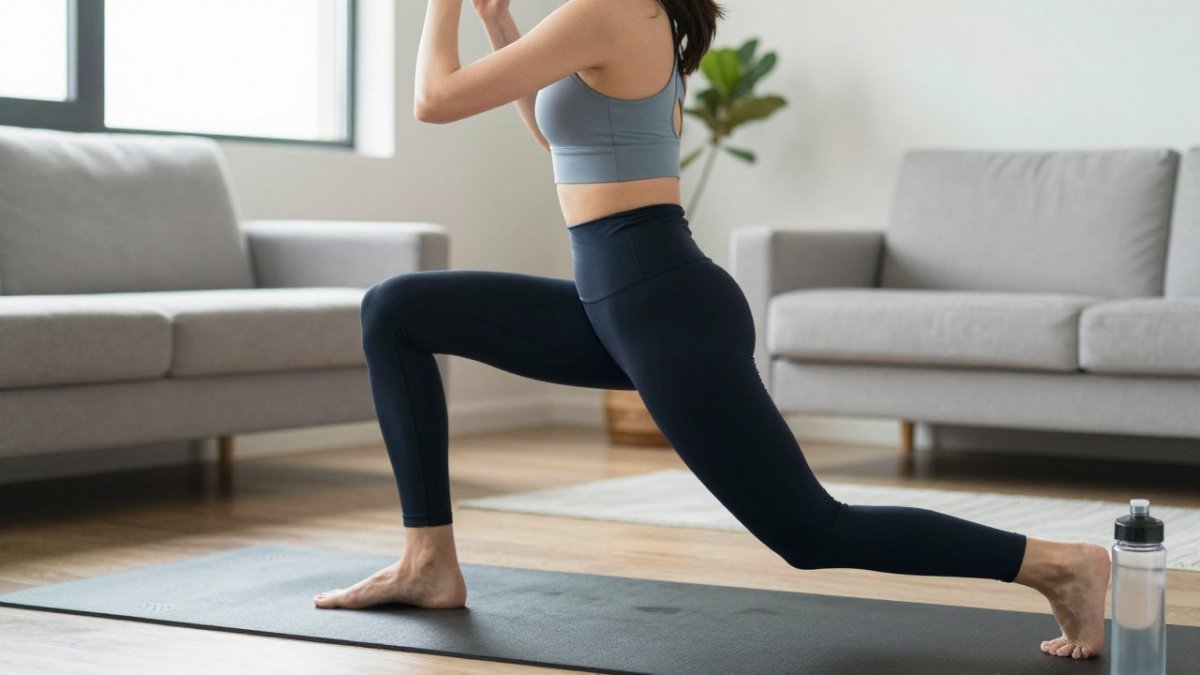
- Standing side step: Step wide to one side, then bring the other foot in. Repeat for 30 seconds.
- Marching high knees: Lift each knee toward your hip while you march in place. Keep your torso tall.
- Box squat: Sit back toward a chair, touch it lightly, then stand. Keep your weight in your heels.
- Step-back lunge: Step one foot back, lower until both knees bend, then return. Switch sides each round.
Use a 30-second work, 30-second rest pattern for your first week. Once that feels comfortable, shorten the rest. Beginners often push too hard in round one. Save your energy for the later rounds so your form stays sharp.
Low-Impact HIIT Exercises at Home No Equipment Needed
You do not need weights, bands or a mat to get a real workout. Everything below works in a small space like a living room or bedroom.
- Modified mountain climber: Hold a high plank with hands on a counter or sturdy table, and drive one knee toward your chest at a time.
- Standing side leg raise: Hold a wall for balance and lift one leg out to the side, then lower with control.
- Glute bridge: Lie on your back, lift your hips, and squeeze at the top for a few seconds.
- Dead bug: Lie on your back, arms up and knees bent, and slowly extend opposite arm and leg.
A Complete 20-Minute Interval Plan
Here is a simple plan you can follow right away. It uses a warm-up, four working rounds and a cooldown.
| Phase | Work | Rest | Rounds |
|---|---|---|---|
| Warm-up | Marching in place, arm circles | None | 1 round, 3 minutes |
| Round 1 | Standing side step, box squat | 30 seconds | 2 rounds |
| Round 2 | Marching high knees, step-back lunge | 30 seconds | 2 rounds |
| Round 3 | Modified mountain climber, glute bridge | 30 seconds | 2 rounds |
| Cooldown | Slow walk, gentle stretch | None | 4 minutes |
Rest for about 60 seconds between full rounds. Aim to finish feeling challenged but able to keep your form. If your heart rate spikes too high or you feel dizzy, slow down and take a longer break. Check with a doctor before starting if you have a heart condition or other health concerns.
Low-Impact HIIT Workout for Bad Knees
Knee discomfort does not have to end interval training, but it should change how you load the joint. The goal is to keep the heart rate up while reducing deep knee bend, fast direction changes, and repeated impact. Treat this as a menu of regressions and progressions rather than a single workout. (Source: Physical Activity Guidelines for Americans)
Start with a longer warm-up than you think you need: 5 minutes of easy marching, leg swings, and slow bodyweight squats to a comfortable depth. Cold joints tolerate less range and load.
Regressions for sensitive knees:
- Shallow box squat: Sit back to a chair and touch lightly, keeping knees behind toes. Stop at the depth where you feel no pinching.
- Standing side step: Step wide and bring the trailing foot in. Keep the pace brisk but the steps short.
- Glute bridge: Lie on your back, press through heels, and lift hips only until thighs and torso form a straight line. Squeeze for two seconds at the top.
- Step-back lunge to a short range: Step back only far enough to feel a mild stretch, then return. Hold a counter for balance if needed.
- Seated march: Sit tall in a sturdy chair and lift knees alternately. This keeps the heart rate up with zero knee load.
Progressions when knees feel stable:
- Add a two-second pause at the bottom of the box squat.
- Increase work intervals from 30 to 40 seconds before adding speed.
- Add a light resistance band above the knees during side steps to increase glute demand without impact.
Use a 30-second work, 40-second rest pattern for the first two weeks. If pain stays at 0 to 2 on a 0-to-10 scale and settles within an hour, you can shorten rest to 30 seconds. If pain rises above 3 or lingers into the next day, return to the regression and extend rest.
Watch out: sharp pain, swelling, or a knee that gives way are reasons to stop the session, not push through. Speak with a physical therapist or doctor before progressing if you have had a knee injury, surgery, or ongoing pain.
Monitor effort with the talk test: you should be able to speak a short sentence during work intervals and a full conversation during rest. That keeps intensity high without forcing knee load. This guidance is general and not a substitute for individual medical advice. Keeping effort controlled makes short bursts easier to fit into a routine, and Launceston Squash Centre offers another way to think about making movement work around a busy schedule.
Calories Burned in a Low-Impact HIIT Workout
Calorie burn is not a fixed number you can copy from a chart. It depends on your body weight, the effort you put into each interval, how long you work versus rest, and how much muscle you use per move. A 150-pound person and a 220-pound person can do the same 20-minute plan and finish with very different totals. See how kickboxing-based workouts support weight loss goals if you want to compare calorie burn across different formats.
A practical way to estimate burn is to use metabolic equivalents, or METs. METs express how hard an activity is relative to sitting still. Low-impact HIIT typically falls in the 6 to 8 MET range when you are working hard, and closer to 3 to 4 METs during rest intervals. You can estimate calories with a simple formula: METs × 3.5 × body weight in kilograms ÷ 200 = calories per minute. For a 180-pound person (about 82 kg) working at 7 METs, that is roughly 10 calories per minute during work intervals, and about half that during rest.
Use that math as a rough planning tool, not a precise tracker. Wearable devices and gym machines often overestimate burn during interval work because they lag behind rapid heart-rate changes.
Watch out: chasing a calorie number can push you to sacrifice form. If you find yourself rushing reps or shortening rest to hit a target, you are trading joint-friendly technique for a number that is only an estimate anyway.
A better progress marker is effort and consistency. Track how many rounds you complete with clean form, how quickly your heart rate recovers during rest, and how you feel the next day.
Start Your Low-Impact Routine at a Studio You Can Trust
Home workouts are a great start, but a class can add energy and accountability. CKO Kickboxing offers high-energy kickboxing classes where you move at your own pace, using real heavy bags and a supportive group.
book a free trial class at CKO Kickboxing to see if our community fits your goals. You can also learn how to pace yourself in workouts before your first visit, and see whether kickboxing fits your pace if you have bad knees.
BUTTON: Book Your Free Class CARD_TITLE: Ready to move without the pounding? CARD_TEXT: CKO Kickboxing offers low-impact kickboxing classes with real heavy bags at your own pace.
Frequently Asked Questions
Is there such a thing as low-impact HIIT?
Yes. HIIT alternates short bursts of hard effort with recovery periods, and the intensity can stay high while impact stays low. Low-impact HIIT keeps at least one foot on the ground at all times, using step-outs, standing side leg raises, marching high knees and step-back lunges instead of jumping. Effort, not bounce, is what drives the workout.
What low-impact HIIT exercises are easier on the knees?
Exercises that keep one foot planted and avoid deep, repeated bending under load tend to be gentler on the knees. Good choices include standing side leg raises, glute bridges, step-outs, modified mountain climbers with hands on a chair and marching high knees at a moderate pace. Keep your knees tracking over your toes and stop any move that causes sharp pain. If you have a diagnosed knee condition, check with a qualified professional before starting a new routine.
Can low-impact HIIT help with weight loss?
Low-impact HIIT can support weight loss as part of a consistent routine. Short intervals of hard effort raise your heart rate, and the calories burned depend on your body weight, the intensity you reach and the total time you work. Because it is joint-friendly, many people find it easier to stick with than high-impact workouts. Results also depend on eating habits, sleep and overall activity, so the workout works best as one part of a broader plan.
Is low-impact HIIT suitable for beginners?
Yes, low-impact HIIT is a practical starting point for most beginners. You can begin with shorter work intervals, longer rests and the easiest version of each move, then add time or intensity as your fitness improves. Avoid pushing to a level where you cannot speak in short sentences, and rest whenever your form breaks down. If you have a heart condition, joint injury or other health concern, speak with a qualified healthcare provider before you begin.
